
Comparison
PVC vs uPVC windows: what the U actually means
The U is not marketing: it stands for unplasticised — PVC without plasticisers. That single difference is what makes the profile suitable for a structural window.
August 2026
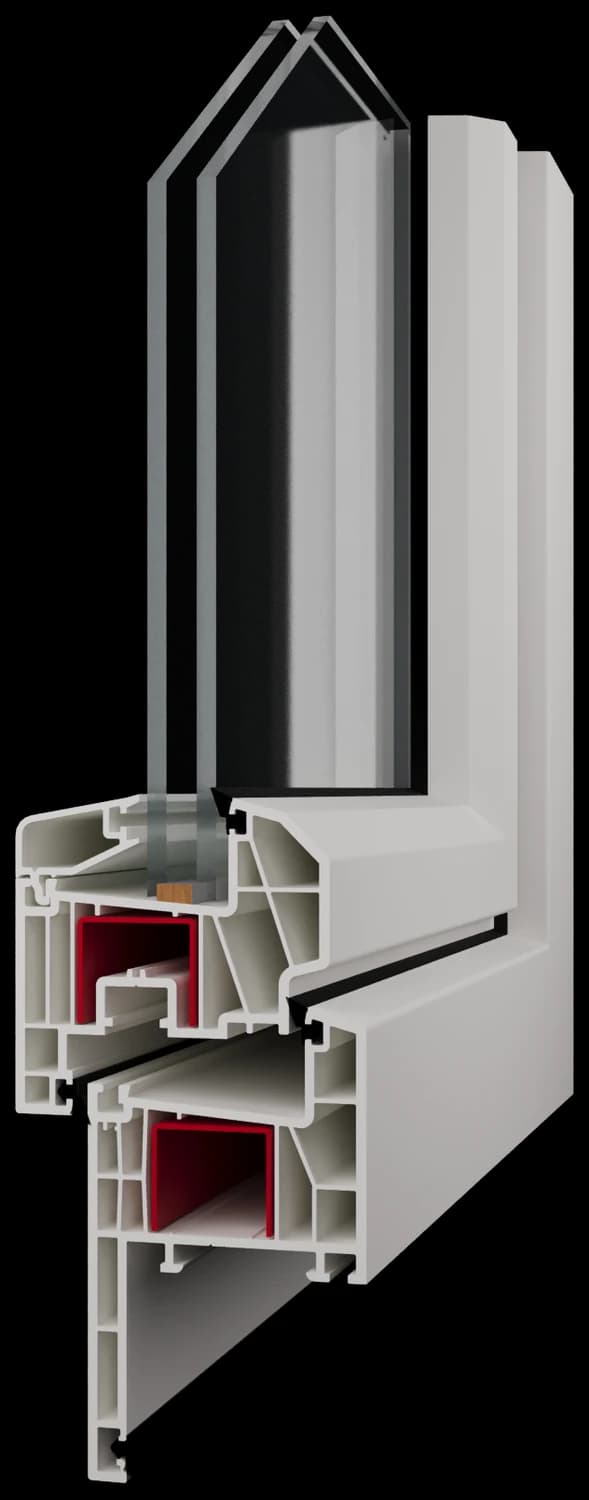
PVC and uPVC are not two names for the same material. Both are polyvinyl chloride, but flexible PVC has plasticisers added to make it soft and bendable — the material of hoses, membranes and cable sheathing. uPVC is unplasticised: rigid polyvinyl chloride without those additives.
Why the absence of plasticisers matters in a window
- Structural rigidity: the profile carries the weight of the glass and resists wind load, which needs a rigid material, not a flexible one.
- Dimensional stability: a plasticised material changes dimension with heat and time, and the opening loses its seal.
- Plasticiser migration: the plasticiser gradually migrates out and the properties drift — a failure mode uPVC simply does not have.
What this means in practice
A window profile is not generic "plastic": it is a rigid uPVC compound, hollow with air chambers, and reinforced internally with a steel bar in the structural sections. The chambers are what give the thermal performance; the steel is what gives rigidity at large sizes. Comparing a uPVC window to any flexible PVC product is therefore a category error.
Across Premier's systems the chamber count runs from 3 in the sliding systems and the SETI casement, up to 6 in the Frankfort Casement 70, which records Uw 1.18 and Rw ≥ 40 dB in the technical catalogue.
The figures above come from Premier's technical catalogue. Final pricing and availability are confirmed by the Premier team against your actual sizes and quantities.
COMMON QUESTIONS
- Does uPVC yellow in the sun?
- How a profile behaves under UV depends on the compound and its stabiliser package, not on the material simply being uPVC. Always ask the supplier for the compound specification.
- Are all uPVC profiles equivalent?
- No. They differ in wall thickness, chamber count, reinforcement channel design and compound quality. Those are the items worth comparing.